The XX Factor: A Woman’s Take for Women Nerds
by Heather Harris
XX Factor TV review – iZombie Season 1
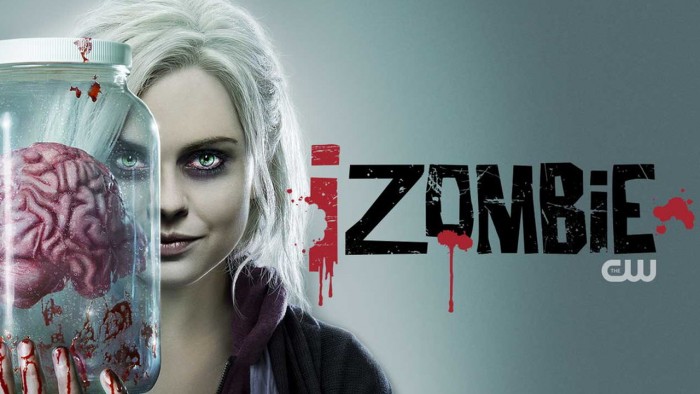
Image courtesy of iZombie.wikia.com
I had taken a small break from the CW network after my fascination waned with The Vampire Diaries and The Originals. Other friends and family members tried to hook me with Flash and Arrow, though I guessed I’d been “meh” for so long that I wasn’t sure what would entice me to return to the network for entertainment outside of Netflix original shows.
Enter Liv Moore, Medical Examiner, who is undead but able to pass as living by eating the brains of the corpses that come to her autopsy table. Don’t eat brains enough? Or get really super upset? She goes into “Full On Zombie Mode”, a phrase I would probably make up too since I don’t think I’m all that original or punny. Eating brains regularly? She’s content. Sounds like a chemical dependency issue but with a public safety net built in with it.
Liv Moore in iZombie was an over-achiever doctor with a fabulous adorable fiancé who had her life all planned out, never strayed from her goals and direction, and was fierce in her passion for saving lives. After being convinced to let her hair down on a boat party with some friends, she unexpectedly is thrown in the middle of a zombie outbreak on the boat and is scratched while jumping into the water trying to escape. Thereby turning into a zombie herself and waking up in a body bag. She eats her first brain on the waterfront to the horror of the recovery team and they run, leaving her to feast and eventually realize self-awareness as a zombie.
But this show takes a turn most other zombie comedy-mysteries don’t, save for a couple projects here and there beginning with George Romero. The usage of memory to center the theme on what it means to be alive, and specifically to be human. Because when zombies eat brains, they not only ingest the proteins and enzymes needed to continue re-animating. They “become” the person who’s brain matter ingested, including memory and personality traits.
When Liv discovers this, she decides to team up with a detective, Clive, in the Homicide Division under the guise as a psychic who has visions. To him, she is quirky, unpredictable, and prone to position herself as a target for prime suspects. He, along with her now ex-fiancé, sister, mother, and brother, are unaware of her zombie-ness. Under this cover, she feels comfortable teaming with her boss in the M.E.’s office and morgue in solving crimes as a zombie, having a source for food at her disposal, and also finding answers for the not just the larger threats like a bigger outbreak looming or zombie hybrids wanting to profit and exploit the system for their own gain and vanity…but also exploring living-re-living other people’s desires, fears, secrets, motivations, loves, etc as a means of stepping outside the self-imposed box she created before she turned. iZombie is a Philosophy 101 course told in light-hearted contemporary fable minus the heavy handed Scrooge’s ghosts lessons: how can the dead teach us how to live?
I still need to watch Season 2. Looking forward to it though.
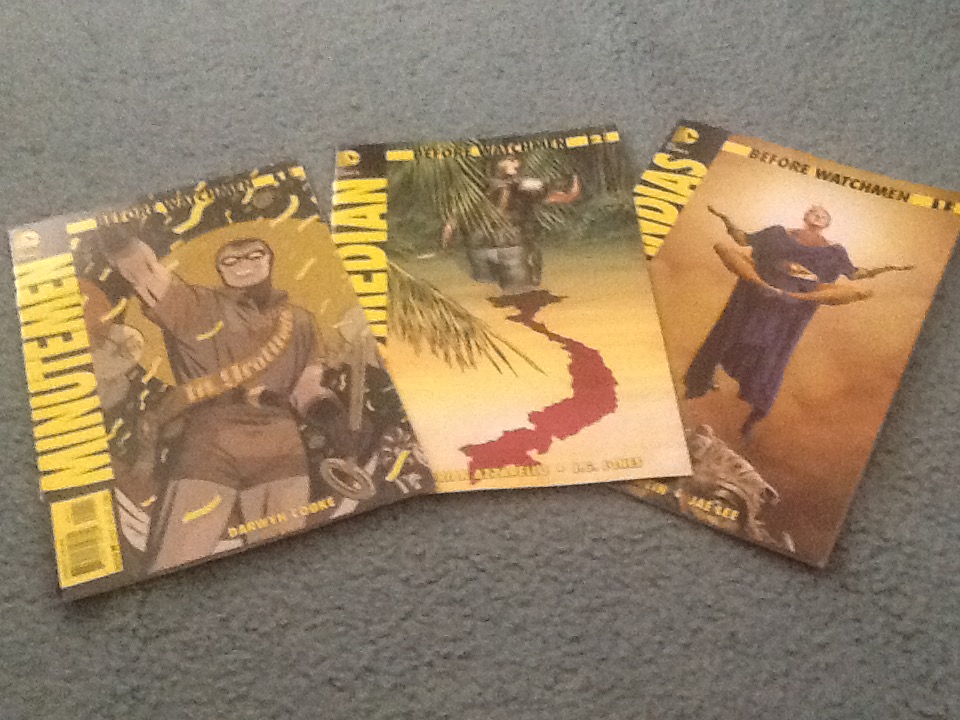
The XX Factor Grab Bag Review – Before Watchmen
When ghosts from the past whisper in my ear to revisit some prequal narrative, I listen.
When DC Rebirth prompts me to recall my experience of Watchmen through it’s litany of JL characters among others, I listen. The ending of the Rebirth debut with the Comedians pin staring back at Batman actually got me jumping up and down and texting the Drunk and Nerdy folk….”WHOA WHOA WHOA WHOA!” I said. I think I said that. I know I said at LEAST one “whoa” in all caps. It was a concept that I think was a ballsy move and allowed the audience to reimagine the universe in terms of a new morality play with – perhaps – a return of Dr. Manhattan.
So when I opened up and read the issues of “Before Watchmen” 6-part series on each of the characters, I was intrigued. I’ve already been seeing the introduction of Dr. Manhattan into a few panels of the Wonder Woman Rebirth series, re-tracing her origins along with a parallel story where she is lost. Currently, Suicide Squad Rebirth is still newer, so I’m waiting on the introduction to make itself known.
Before Watchmen had all the trappings of creating an engaging and meaningful addition to the philosophical trappings of Watchmen, where the characters gave humans reason to vastly question their existence. I was ready to sink my teeth into a Silmarillion type of origin storyline that we didn’t get to see but found lost footage or a journal nobody knew about. I read in my grab bag purchase “Ozymandias”, “Comedian”, and “Minutemen”. I thought, YES. Here’s a fantastic spectrum of morally complex characters. Comedian saying, “Know what happened to the American Dream? We got it.” Paired with killing protestors. Or something like that (laziness is upon me).
Show me something relevant, juicy, cringing.
I got “meh.” You can get the similar arcs in the original work. Watchmen gave a fleshed-out dialogue between characters that showed pertinent philosophical and political debates such as weaponized detachment in a world that glamorizes detachment and objectivity. Before Watchmen is like these same dialogues and confrontations in a little more detail and a lot more apathy. Like drinking nuked leftover coffee.
Just go read Watchmen or watch the 2009 film (even though it deviates, it still captures much of the paneling and the overall tone). I’m doing that to reboot my memory on the Rebirth. See what I did there?
You’re right. I could have done better. I understand. It’s how I feel right now.
“Elektra’s Disappointed Sai: Part 1 – Greek Origins Can Only Do So Much”
When a ninja assassin who is named after a greek titan leaves us wanting more, somebody needs to pay. The Bechdel Test – the pop culture metric used to determine female representation in works of fiction – has nothing on a character arc with enough holes to sink a ship.
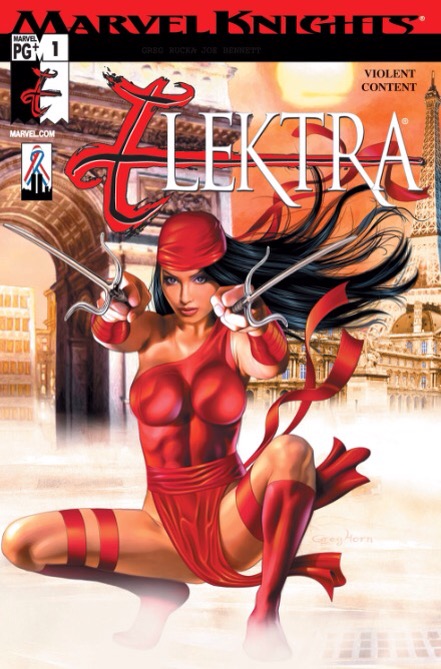
Bendis/Austen
On March 18, 2016, Netflix will release its second season of the highly anticipated show “Daredevil.” The success of the first season rallied around the casting, the fight choreography, the faithfulness toward the spirit of the Marvel comic, and finding high ratings with both fans and critics. Some details were slightly off, such as the relationship between Kingpin and Vanessa, and the weapons of choice for Matt Murdock, but overall Daredevil and Netflix found themselves to be an exhilarating pairing.
When I lost myself in the Marvel universe which centered around Hell’s Kitchen and the journey of Matt Murdock into a beautifully spun web of superhero ethics, I expanded my exploration: paying closer attention to the character arcs of the supporting cast. Foggy’s trust issues, Karen’s paranoia and closets full of skeletons, Kingpin’s justification for violence, Madame Gao’s underground despotism for marginalized labor advocacy, and Stick’s adherence to form and practice and art at the cost of childhood role-modeling all gave me fodder for how their subplots offered the main character multiple encounters of facing his own demons. Internal conflicts are as numerous as the sounds of sirens in New York City. As a former resident of NYC myself, I can attest to how often that happens….think of changes of weather in the Midwest. Or better yet, how many damn squirrels you see on a daily basis. There’s your measuring stick. In other words, Murdock has to face his demons as often as the family dog barks at squirrels running past the window. Such is the ferocity of the first season of Daredevil, and such is the source of a fantastic and nuanced narrative.
As we began the Netflix series with a resounding YES for the pilot season, we will now encounter the hurdles of the sophomore season with furthering subplots and character arcs while introducing new and integral characters to Daredevil. While I’m as excited as the next fan who crushes all over Jon Bernthal as Frank Castle/Punisher, the character I have found myself wanting more from in the trailers has been Elektra. Unfortunately, I have also found myself wanting more from the writers on the character of Elektra in the comics as well, and a part of me is hoping Daredevil Season 2 will give us a “Peter Jackson miracle” and turn a teensy amount of content into a monster of an ensemble story.
Elektra is a fascinating character. But just as her arrival began to get interesting in the comics, Frank Miller wanted her death-by-skewering in the Daredevil Comic to be the permanent kind of dead and not the re-animated kind like just about every other major comic character in existence. I have to ask “Why?” Her backstory is ambiguously exotic, her love relationship with Murdock is passionate and honest, and her own journey through The Moral Dilemma is as dynamic as his. It’s no surprise (and I’m sad to say this) that the dichotomy between male and female hit screenwriters shows the gap between story arcs of two amazing Daredevil Antagonists: in this case, Punisher and Elektra.
What do the trailers tell us about Elektra? Name a trope, and we might cover some good ground on that alone. She’s bad ass. She’s beautiful. She’s deadly. She knows info on the Yakuza that Murdock wasn’t aware of and helps him by sharing. Through her entrance we will see The Hand’s dark and overwhelming presence in Season 2 come into full effect in which we are sure to see a return of Stick.
What does the comic tell us about Elektra? She met Murdock at Columbia University as a political science major. They fell in love quickly and deeply. Her father is an ambassador. A year into the love relationship her family and security were held hostage. Murdock used his powers and his cane to infiltrate the captors and injure them one by one. Police outside mistook Elektra’s father as one of the captors and shot on sight after a hostage was seen injured. Her father’s death shattered her world views and Elektra realized her path to justice was irreconcilable with Murdock’s deeply held convictions. She found justice through assassination and as a bounty hunter, a persona that is the very antithesis of what Daredevil cherishes, as seen in their reunion through a botched assignment.
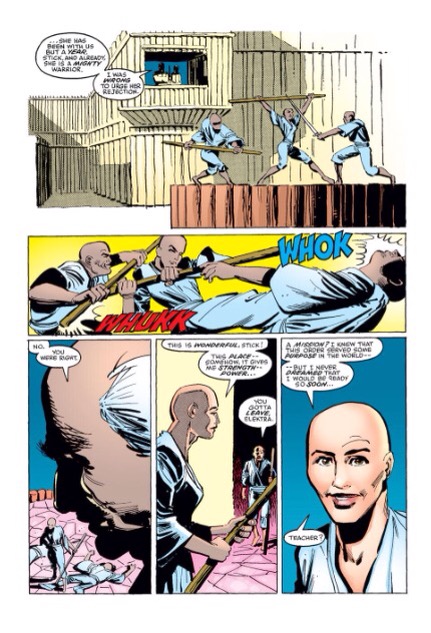
Miller/Janson
Keep in mind, I have refused to watch the 2003 film version of Daredevil starring Jennifer Garner as Elektra or the 2005 stand-alone film, Elektra, hearing the incarnations were an atrocity and an abomination on the industry that took years from which to heal. So, I’m continuing that moratorium on good faith that they are no help in my quest to find a better understanding of Elektra.
That leaves us with her stand-alone comic series. And her words to start with:
“Once upon a time… there was a beautiful princess. So the warrior princess became a ronin and a whore. A warrior for hire. She sold her talent and rage to anyone willing to buy it. But she found that her life ran in cycles. That the same players came in and out of her life no matter how far she ran and no matter how much she learned. Old love kept returning. And old debts left unpaid came back to haunt her. And even that final disappointment of a warrior’s death brought her no peace. Because the way of the ninja is to know that life and death are nothing but energy pushed and pulled. The princess was brought back to life. Brought back from ‘the Place of No Name’…to finish a fight she did not start.”
Most rebirth myths are centered around redemption, but Elektra tells a different story. One encapsulated in constant struggle with the loss of a father and a fight with a real and/or imagined mother figure. She fights for the love of a devoted man/protective-father-figure, discovers the loss of herself in the process, dies metaphorically or literally, and is reborn in the hellish cycle of what has been used in archetypal and classical human psychology as the “Electra Complex”. This complex is the literal gendered opposite of the Oedipal Complex, and we see it reborn repeatedly in the Marvel story of Elektra, however piecemeal it has been offered.
I’m filling in these holes, goddamn it. Because if her story is the metaphor of a psychological state, then she’s one-dimensional. Whether that was intentional or not, I call bullshit, so here I come with my analysis offering some much-needed depth for fans of the red-wearing femme fatale.
“Part 2 – Elektra Conquers Distractions, and So Should We”
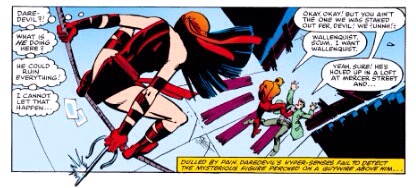
What we DO know as primary motivators for her decision-making in this series, besides her relationships with men, namely Daredevil, is that she trained extensively for combat and for hire. In so doing, her accomplishments have been listed as a resume for the Bad-Ass Female Trope, yet it’s vital to refrain from doing so, for her training offers a story of life conflict and lessons unrelated to her love complex. She need not be a footnote nor a mere helpmeet for one of her male protagonists. Her life story and how she survives as an assassin – as a cold and calculating mercenary – is key and ought to be held front and center.
Miller/Janson
In her stand-alone story, created by Brian Michael Bendis (against Frank Miller’s protests to leave her dead…which I have to point out yet another conflict that some villainous dude always wants to kill a wayward woman while some knight in shining armor dude always wants to save her…even beyond the comics, but I digress), Elektra was trained by The Hand. This ninjutsu organization and training camp originated in the 16th century to assist nationalist warlords seeking power and domination through assassination and espionage to gain information. Elektra Natchios, disillusioned as a world-class gymnast who loved and feared her father (the perpetrator of a child rape memory recalled by her), and watched him die while she lay helpless, began her journey of complete subjugation of compassion and realization of vengeance. She isn’t judge and jury, but a willing and skilled executioner.
Throughout her stand-alone, which occurs after her reunion with Murdock in the Daredevil Series, Elektra is forced to face her demons time and again. What annoys me, however, isn’t the portrayal of her ferocity or her anti-heroism, but how hot she looks in her red leotard as the focal point. Were I to suggest something to all writers who have collaborated on her story arcs in over 800 issues in the Marvel universe, it is that somebody needs to create the mood, the scenery, the dialogue, her costume, etc., to define her as more ruthless and calculating, making her physical appearance, and how alluring she is, as secondary or tertiary. If she truly IS the deadliest assassin in the world, she certainly isn’t provoking the same kind of fear as Punisher.
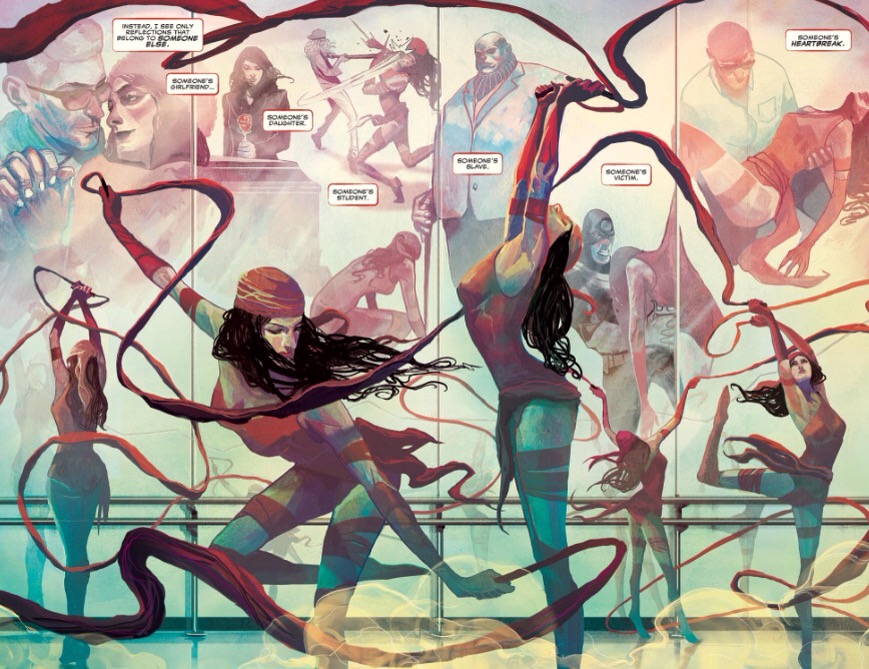
Which brings me back to the upcoming Daredevil Netflix series and my bated breath. We’ve come a long way in diversity with the Big Two in DC and Marvel, but perhaps it goes without saying: we need to keep pushing forward. I challenge the writers to place the blinders on Elektra’s physical assets except for same amount of time given to the six-pack eye candy moments for Murdock. Instead give her more evasiveness and residency in the shadows. Give her icy stare from a dark corner and not from a sultry body position. Highlight what her sai weapons are doing and not what her legs are wrapping around. A fully realized Elektra comic would be one of the bloodiest and most violent series in existence, were her title of “Deadliest Assassin” true to form – not the equivalent of a masturbatory fantasy of a faux role-play ninja-chick.
Del Mundo
Daredevil needs a more daunting challenge than this. His love for her shouldn’t be challenged in a pedestrian manner, one where the ex shows up on his doorstep looking as beautiful as the day she got away. If she is a character that Daredevil truly feels diametrically opposed to, she needs to embody the visceral disgust that comes from the overwhelming sense of dread she brings to a room.
If anyone can write this, it would be Netflix. Jessica Jones realized the trauma of PTSD and rape effectively on screen without distracting from the entirety of the character or the story. Netflix also had no qualms ensuring that Jones herself was portrayed as an asshole yet fully human, battling her demons and Killgrave at the same time. A female character with nuance, bad-ass but non-sexualized, battered but not helpless, traumatized but with full agency. Will we see the same humanity offered to Elektra?
Daredevil, Season 2, here we come.
Originally published on Drunk and Nerdy http://www.drunkandnerdy.com
_____________________________________________________________________

The XX Factor: It Was Beauty
Who Killed the Beast
Part One: Why We Can’t Have Nice Things (Like Perfection)
Image Comics released its first arc of the new series The Beauty in 2015 and is well into
its second arc at the moment in 2016, and just like many other Jonny-come-lately
moments I experience as a middle-aged woman in the Twitter and Snapchat universe, I
became acquainted with a good story and better concept well after the local comic book
store discussed it. On a ladies night, no less. But such is the typical day of a target
demographic who decides a cutting-edge product or series becomes mainstream. We
white academic aged 35+ women have a tendency to be right behind the curve bumping
something cool up to mainstream status with numbers and access to just enough
disposable income. We buy useless shit instead of useless real estate that old white
men waste money on. We have Botox parties, too. Botox parties, wine with paint-by-
numbers nights, and designer puppies. We can be really goofy and evil as an
economic force.
Which is why The Beauty is a reflection of this goofiness. We pay people to inject
botulism in our faces, cut us open and stuff silicone as bubbles of faux subcutaneous fat
stores, and even go so far as to pay someone to slice off labia to appear younger and
more virginal in bed with genital cosmetic surgery. And then we privileged Real
Housewives will collectively gasp at Female Genital Mutilation in communities where
brown skin and abject poverty reigns supreme. The Beauty takes this goofiness to a
whole other pandemic level.
Imagine a world where a sexually transmitted disease causes one to become
conventionally beautiful. Who would be the ones to popularize it? Who would profit
from it? And who would be sure any hazards to human health would be glossed over or
denied altogether for the sake of perpetuating this corporate brand of insanity?
Don’t think too hard, now. Just go visit your local Panera and look around.
What The Beauty does is challenge us to realize our bodily ethics, body shaming
practices, and body phobias as an economic model with a twist. Cosmetic surgery is so
last millennium. Let’s make infections sexy. Thanks to research and development, STI’
s suffer most from stigmas. We need something deadly again, and The Beauty
captures ALL of these elements.
Part Two: If You Got the Money, Honey, We Got Your Disease
What I’ve come to appreciate about The Beauty, now nearly finished with its second
arc, is it’s ability to begin with the central storyline around two figures coming to terms
with their own contraction of the disease. Vaughn and Foster, both investigators in law
enforcement, discover a corpse that had just combusted internally on the subway that
was a confirmed infected case. The story opens two years after the virus was
introduced (whether intentionally or mutated naturally, that hasn’t been discussed yet)
into the human population. Half….HALF…of the population has contracted it, with the
culture responding to the new reality in various but predictable ways: religious sexual
repression, DHS and the CDC investigative operations treating this like a First Child
How-Do-We-Adult-This, Congress reps entertaining suspect lobby interests, Dark Web
wanna-be’s wondering how to survive while seeking cures/antidotes/profits in an-as-yet
unregulated market, and of course cops. Detectives-are-us characters who we hope
can get some answers for an obsessive mob of citizens.
Vaughn and Foster eventually discover that this virus is not just a fad, but is deadly as
in Ebola-deadly. But with a fireworks display as patients combust and their entire
internal organ systems flare up suddenly. They discover it’s deadly, and that there has
been a cover-up by people in power both above and below acting in collusion to keep a
population under control. We can’t let half the population who has the virus know they’
re gonna turn into volcanos. That would hurt ratings and profit margins and recruiting
efforts. People are loving their abs right now. Well, that or the non-patients despise
patients because of an extreme form of meritocracy bearing down on cultural beauty
standards. You didn’t earn that, you weren’t born with that, you stole that, you’re a fake
beautiful person. The divide that already exists between the beautiful shiny people and
the 6’s deepen greatly in the comic.
Here’s what’s seriously amazing about this story that I’m salivating over. It’s a disease.
Diseases. Don’t. Discriminate. All people, regardless of gender, race, class, orientation,
and gender identity are one sexual encounter away from perfection. Something that
was once regarded as safely kept for royalty, the rich, or with genetic luck of the draw,
half the population blazed through that paradigm and forced society it’s hand. Beautiful
people succeed more in money, love, and status according to beauty standards de jure.
Well, the floodgates have opened. Now what?
The Beauty is attempting to answer that question.
Part 3: Mirror, Mirror, On the Wall. Tell Me Something I Want to Hear.
Several instances throughout have characters looking themselves in the mirror, offering
their bodies for sale, and acting as spokespeople for a side – whether as infected or non-infected. It all whittles down to this question: what is your price?
These dilemmas are a favorite of mine as thematic devices for a story. I often times wonder what our price is for selling out our standards for a type of security, quality of life, feeling of acceptance in the majority tribe (so to speak). Money speaks. Sex sells it. And here, disease insures. When we reflect – like the characters reflect – the internal bargaining and justification begins. For Vaughn and Foster, as well as Timo and eventually Ezerae in the second arc, the downward spiral and upward spiral intersect between social mobility and ruin. All because they found themselves perfected into beautiful people.
Coming soon, Vaughn (who took the experimental antidote), Foster (who began the
Anti-Beauty pandemic a-la Twelve Monkeys style), Timo (escaping hitman identity), and
Ezerae (trans woman escaping assassin identity AND male identity) are all facing this unchartered territory of stealing beauty from the economy. They all are finding impacts of an unregulated STI reality on themselves and their loved ones. And they all are discovering the price they are willing to pay for feeling a sense of control in an out-of-control pandemic.
Rating: 3 out of 4 stars because it’s still ongoing and too new for me to say 4 stars
Alcohol consumed: ¾ bottle of good cheap moscato
Check it out: https://imagecomics.com/comics/releases/the-beauty-1
 Heatherisms